Showing posts with label permaculture. Show all posts

Thursday, 18 June 2009

'Cloning' Aspen Trees

On our small acreage we have a spot where there used to be trees, but there isn't. When this house was being built (by the previous owners), a section of the aspen poplar trees was graded away, probably to make the septic field. Other than this ~25 ft long section, the rest of our acreage is ringed with these aspen trees. We refer to the place with no trees as 'the gap.'

We have attempted to fill 'the gap' with tre
es in a couple of ways already. First, we tried to dig up some little aspen trees from elsewhere on the acreage and re-plant them. This didn't work, because, as we found out when we dug them up, they don't have individual taproots. Instead the new little trees emerge from the buried roots of bigger trees. So these uprooted little trees died in short order, even when we managed to dig one out.

Our second try was to buy some pre-rooted seedlings from a tre
e seedling company last summer. These were bare-root saplings that were each about 1 1/2 - 2 feet high. We planted five of these aspen saplings in 'the gap' at the same time as we were planting about 20 other small trees (maple and spruce) from the same company all around our place. Well, it turned out to be pretty much impossible to keep up with the watering on all of these trees. (I don't recommend planting this many trees at once unless you have someone at home who can commit to watering them as often as they need it, which was pretty much every day.) We did keep them alive for a few months, but then the deer nibbled the tender tops off, and later the neighbor mowed over the property line and took one tree down to about three inches. Even that one lived for a little while, but this year it is quite dead. One of those five trees has leafed out a little bit this Spring, so there may be some hope for it.

I would love to just go out and buy some 10 ft tall aspen trees to fill in the gap, but that gets expensive. The nurseries also tend to stock more 'decorative' varieties than this one, so chances are trees from a nursery wouldn't really look right in the gap anyway. So, when I found this "rootpot cloning" system, I decided to give that a try instead.

First, we picked out 10 trees that looked healthy and were not too big and not too small. Then, I
followed the instructions as best I could and used a paring knife to cut a small ringed section of bark out of the tree stem - this is called the 'wound,' apparently. Some rooting gel goes on this 'wound' to encourage roots to emerge from it. Next, I dunked the folding rootpot into some water, to fill the reservoir at the bottom of the pot. Then I put the folding rooting pot around the tree stem and clicked it shut. In went the moist, soil-less potting mixture, while taking care not to wipe off all the rooting gel from around the 'wound.' Then I put on the dark stickers, to keep the light from the newly growing roots. Finally, I topped the pot off with its dark colored lid. Once a week I add water to the reservoir with a syringe - this part has proved the most challenging so far since the place to put the syringe is so small, but I have managed it. (But I'm not looking forward to it when there are tons of ants and mosquitoes around!)

According to the rootpot people, in about 8 weeks there will be a rootball formed in the rootpot which, when severed from the rest of the tree will give me a free-standing sapling equivalent to one that is about four years old (3 - 4 feet high). I can then plant these ten sapling 'clones' in the gap, all for a total investment of about $30 dollars and a few hours of my time. The stems of the trees I lop off in 8 weeks should regrow other branches, maybe even with some kind of topiary effect. So I am not killing any trees in the process, which is good - I want more trees, not fewer.

I'm quite excited about this whole process, and I'm really looking forward to having 'the gap' filled in at last. There is something about an unfinished circle that makes me want to try and complete it, somehow.

Friday, 17 April 2009

Tale of Five Seeds - The Planting

Back in January, I wrote about the five seeds I was going to plant this year as part of my participation in the Seed and Plant Sanctuary of Canada.

Last weekend I started four of the five varieties of seeds: French Sorrel, Echinacea, Parsley Giante D'Italia and Chinese Rhubarb. The fifth seed, Golden Rocky Beans, won't be planted until I actually start direct seeding the veggie garden itself. That will be about a month or so from now, maybe three weeks if I can get ready in time. I'm trying to be a bit more organized about my planting this year, although so far I'm not sure if I'm having much success!

Earlier this week Gord and I went to two gardening seminars, instructed by The Urban Farmer, Ron Berezan. The seminars were on Xeriscaping and Edible Forest Gardens, and both Gord and I came away from that with visions of an Eden-like garden on our property, with us meandering down paths and plucking fruit and veggies from here and there at will. Well, it will be some years before that happens, but with the help of Mr. Berezan, we at least know where to start!

This weekend we have managed to arrange for two whole days at home, so we will hopefully get a lot of things done around the yard, and some prep work done to the garden. I was a bit dismayed to see weeds growing in there already - they were at least easy to pull out, since the soil was so moist. The Urban Farmer recommends mulching all exposed soil to retain water and reduce weeds, so I will have to look into that more seriously this year.

Spring is certainly well on its way now, and with it comes both the excitement of a new growing season, and feeling a little bit daunted about all there is to do. But there is comfort too, in knowing that the soil, seeds and sun have done this every year since the dawn of time, and so maybe I don't need to worry or fret quite so much about getting things 'just right.'

Wishing everyone a wonderful weekend, with some time for tea and relaxation!

Thursday, 26 June 2008

Tai Chi, a Tree and a Pickle Recipe....

Yesterday was a good day. I try to see goodness everyday, but there are days when you really have to look for it, and then days like yesterday, where gladness walks up and wags its tail at you like a puppy. All sorts of good things happened yesterday, but there were three things that happened all in a row within the span of an hour or so, that had me bursting with enthusiasm and gratitude.

The first two things happened at the Farmer's Market. More and more, this doesn't surprise me. Gord and I were wandering around the market before going to Tai Chi, and we ended up at the table for Shallow Creek Nurseries. I had popped by their table a couple weeks ago and noticed that they were selling some very hardy (Zone 2), yet sweet cherry tree varieties that we had learned about when we heard the Urban Farmer talk a few weeks before that. We ended up buying a Cupid Cherry tree, which already had cherries on it, which we will be able to harvest in about two more months! And this already-fruit producing tree cost us the grand sum of 22 bucks. As soon as Gord heard the price he zeroed in on the little tree, and bought some strawberries to boot!

The second thing happened up at the Lindbrook Farms table, where they sell delicious cucumbers. I gobble these things up like popcorn if I don't watch myself - I can eat 5-6 of their slicer cukes all at once. Back at the table, Gord is being his silly self asking absurd questions about cucumbers and pickles and how you make one into the other. Eventually the vendor lady finds out I don't have a clue about pickling and she says she has a very good recipe for first time picklers that she will happily share with me when they bring the pickling cukes out later in the season. I am taken aback at the generosity, and when we leave the table Gord and I agree that this sort of thing just wouldn't happen at the grocery store.

The third thing happened just a little while later, after I've eaten a cucumber, changed into my Tai Chi clothes and joined Gord and the rest of the members of my Tai Chi class. We are doing the warm ups as usual, and the instructor gives us a little extra instruction on one of them, called the Tor Yu. I have struggled with this exercise and it can bother my knees sometimes. Today for some reason the instructor's way of talking about and demonstrating the move tweaked some part in my brain and body, and I finally got it. I could do it! I could use my leg strength and not my knees! I could do it over and over again! This completely changed how I did the entire 108 move set, and I was a chatterbox about it for the rest of the class. Tai Chi is good for teaching me that repeated effort and practice, without apparent progress, can come to fruition any time. This gives me hope, and for more than just my Tai Chi.

Then, when we went back after class to pick up our tree and strawberries from the Shallow Creek lady, I mentioned I was thinking about building an arbor and trying to grow grapes in our yard one day, she offered to teach me which varieties to grow and how to prune them.

Things were coming to fruition (fruit-ion?) all over the place yesterday! It was a good day.

Picture of cherry courtesy this flikr site.

Saturday, 10 May 2008

Creating an Edible Landscape

Earlier this week Gord and I attended a class put on by Edmonton's Urban Farmer, Ron Berezan. The class was held in the lush environs of Salisbury Greenhouse - I can't remember ever having a greener classroom! Plants everywhere, nicely humid air, the sound of fountains in the background, filtered light coming through the greenhouse roof and later, the sound of rainfall.

Here is the description of the class:

"Creating an Edible Landscape - Growing your own food can be extremely satisfying with great benefits for your health, your pocketbook and the environment. Based on permaculture principles, this workshop will explore unique approaches to integrating fruits, berries, herbs and annual and perennial vegetables throughout the landscape. "

This was a fantastic class, and all for the great price of 5 dollars! It was very well attended, and almost everyone there was scribbling notes about all of the different types of edible plants that are suited to our Zone 3a plant hardiness area.

I'm amazed at the variety of plants we can grow here! For example, we can grow several varieties of pears and plums in addition to apples. There are even several types of cherry trees that are hardy enough to survive our winters, and get this: grapes! There is a hardy kiwi tree that will grow here, too. There are lots of berries that are native to this area, such as Saskatoons, and Sea Buckthorn. The Beaked Hazelnut tree is native to Alberta as well.

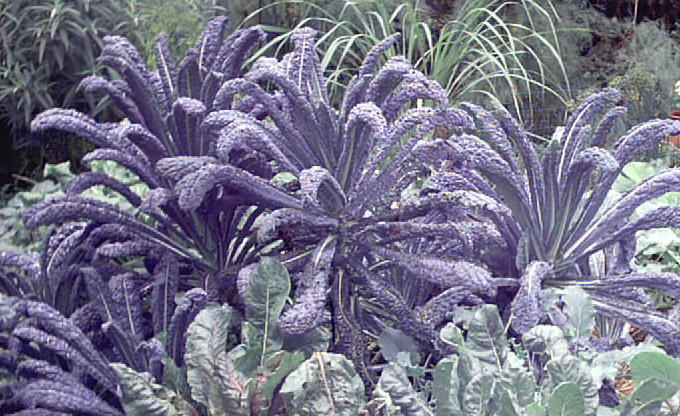
The instructor also talked about the beauty of food plants, and how they go well in any garden, whether it be for decoration or not. As you can see from the picture, Rainbow chard is gorgeous, and there are so many different colors of kale too. He described how to create a 'spiral herb garden' which is made from a small mound of earth, that takes on different micro climates depending on which side of the mound the herbs are on-- oregano and rosemary go on the sunny side, parsley on the shady side, and lower down. Plus, the mound creates more surface area, and visual interest, than a flat spot would. I couldn't take notes fast enough! Fortunately, a comprehensive list of plants native to Alberta and edible are available on his website, here.

He spoke for a while about Thomas Pawlick's book, The End of Food, and how for example, a tomato contains fewer vitamins and more fat (!) and sodium than it did 30 years ago. He recalled how a nutritionist at one of his workshops had commented on this being the reason why the Canada Food Guide has to keep revising its portions of fruit and vegetables upwards, because the industrially grown varieties just don't have the vitamins and nutrients that they used to.

It was a most informative and enjoyable way for Gord and I to spend the evening, and work on the Independence Days challenge at the same time!

Gorgeous rainbow chard picture courtesy this flickr site

Saturday, 12 April 2008

Edmonton's 100 Mile Diet and The Urban Farmer

Yesterday, CBC Edmonton hosted another one of their popular lunch time forums. The topics were right up my alley, and so I headed over to the radio station's downtown location on my lunch hour. I was eager to hear about how Ivor and Lana McKay are managing, 10 months into their commitment to eat an Edmonton-based 100 Mile Diet. Winter weather spans about 5-8 months of the year here, so eating locally under these circumstances poses certain challenges. And I was also excited to hear The Urban Farmer, Ron Berezan, speak about growing much of his family's food right in his own back and front yards, also right here in Edmonton.

I wasn't disappointed. Ivor spoke for about half an hour, talking about the joys of eating locally, capturing his own yeast to make bread, and about all the farmers and other people he and his wife and family had connected with over the course of the past 10 months. He has also been working with Edmonton-based economist David Anielski, author of 'The Economics of Happiness', to work out a business case for the frugality of eating locally, showing how food trucked in from California might boast lower price tags, but costs much more overall in terms of health and wellness when you consider the time and effects of long-distance transportation and the lower nutrient value of mass produced food.

Ivor spoke brielfly about food security as well, noting that there is only 3 days' worth of food in the city for everyone, if the delivery system were to be shut down, for example, due to a pandemic breakout in the US. He briefly mentioned 'peak oil' as well, which was the first time I think I've heard this term actually mentioned on a mainstream radio station. Ivor and his wife plan to continue their 100 mile diet, with the addition of a few non-local things, such as canola and olive oil, as well as vinegar and ginger. And they are working with co-presenter Ron Berezan to start a permaculture garden, recuding the miles their food travels even more.

In the second half of the forum, Ron Berezan spoke about permaculture, and how even apartment dwellers can grow some of their own food, on their balconies and in containers. He showed pictures of his own back yard, which resembles a small, dense forest in some areas, and lush sunny areas in others. Much to my surprise, he says that Edmonton has the most community gardens in Canada - I think he said we had 65! He talked about roof top gardening and was on hand afterwards to answer the audience's gardening questions.

In the question period after the presentations, I suprised myself by volunteering a comment about how community supported agriculture farms are also a good way to eat locally and support local farmers. At least that's what I think I said. I was pretty nervous!

All in all, it was a great Friday!

Picture of echinacea flowers from The Urban Farmer's urban farm!

Saturday, 29 September 2007

Garden Update

Today was the day I took all of the last useful bits out of the garden. The things you see still in there won't likely grow anymore (e.g., feverfew, oat grass, some peppers that never grew much in the first place), but I didn't pull them out and probably won't. I'll just leave them in there to compost themselves over the winter. As far as I know there aren't any seeds left on anything, so I'm thinking that should be ok, but I'm just sort of winging it here.

I've mulched the strawberries with timothy straw - the hard and stemmy bits Corky and Scooter, our two guinea pigs, leave behind. I'll probably keep adding to this mulch for a few weeks yet so there's a good layer of insulation over the winter. From what I've read it's good to do this to the garden too, so with Corky and Scooter's help, I'll have a fair amount of straw bits to add to the garden until the snow comes.

When I picked out all of the remaining salad greens and carrots, I had a little surprise: A 'white' carrot. This is the only one of these I came across all year. I don't know if it's just an anemic carrot, or actually a different type of carrot altogether that was mixed in with my other carrot seeds. I haven't tasted it yet - I'm waiting to show it to Gord when he gets home from work.

I really enjoyed our little garden this year! I plan to add another 4X4 bed next year and change my plantings a bit based on what did well and what else I want to try, like potatoes and maybe some cucumbers or squash. I also want to expand the herb garden, but I'll probably do that in a permaculture-style, with herb plants strewn about among the annuals and decorative perennials. Eventually I'd like to have virtually all the plants I grow be edible or otherwise useful. I've got a lot to learn, and a lot of winter reading to do!